
Shadeports Cape Town
Shadeport installation and repairs in Cape Town
Shadeport vs Carport: What Is the Difference and Which Should You Choose?
A shadeport is a steel frame roofed with tensioned knitted shade netting. A carport is the same footprint roofed with solid sheeting — IBR, Chromadek or polycarbonate. That single difference in roof material decides the cost, the heat under the roof, the rain behaviour, the wind loading and the maintenance pattern, and it is why the two are priced and chosen so differently in Cape Town. Shadeports Cape Town builds the netting kind.
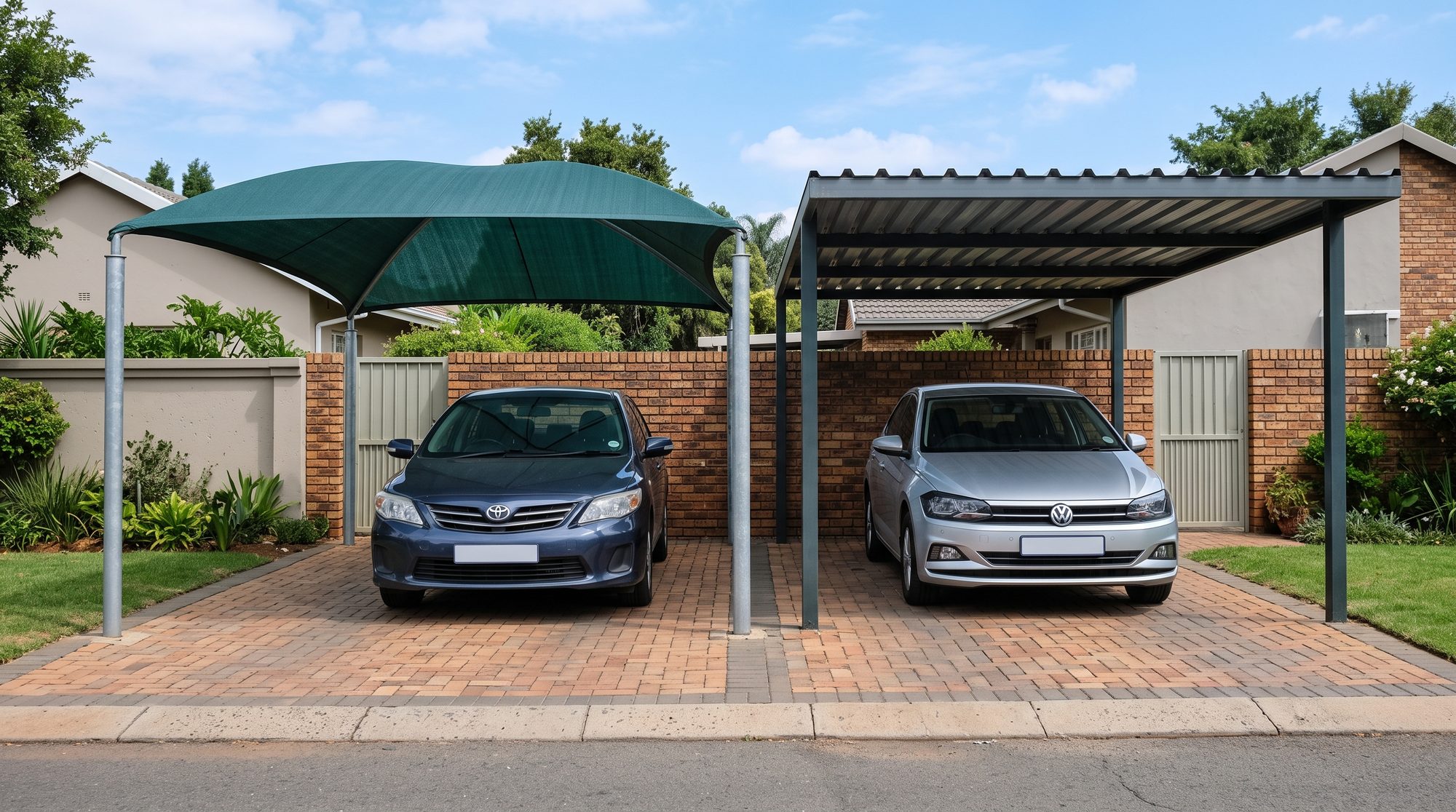
Netting on the left, solid sheeting on the right: same footprint, different roof.
The Difference at a Glance
| Factor | Shadeport (netting) | Carport (solid roof) |
|---|---|---|
| Double bay cost (2026) | R13,500 | R25,000 – R35,000 |
| Rain | Passes through (waterproof fabric optional) | Fully dry |
| Hail | Net absorbs stones; car protected | Car protected; sheeting can dent |
| Heat underneath | Cool — heat escapes the weave | Warm — sheet traps and radiates heat |
| South-easter wind | Bleeds through the fabric | Loads the roof as lift |
| UV protection | 80–95% blocked | 100% blocked |
| Maintenance | Tension checks; re-net after ~10–15 yrs | Fastener re-screwing; sheet care |
| Look | Soft fabric line | Roofline extension of the house |
When the Shadeport Is the Right Choice
Sun is Cape Town's daily enemy and rain its seasonal one, which is why netting wins most residential decisions here. The shadeport case: half the price of solid roofing per bay, the coolest parking a structure can give, hail absorbed without marking either car or roof, and a fabric that ignores the south-easter that shakes sheeted roofs loose. Paint fade, dashboard perishing and cabin heat — the things that actually age a parked car in this climate — are UV problems, and a 95 percent net removes them from R10,500 installed.
When a Solid-Roof Carport Wins
Full dryness is the solid roof's one decisive card: a vehicle, trailer or workshop area that must stay bone-dry through winter fronts belongs under sheeting, and a carport tied into the house roofline can suit a façade in a way fabric does not. The costs of that card are the higher price, the trapped heat, and the wind maintenance. Specialist carport installers serve that market across Cape Town; netting structures are what this company builds.
The Middle Ground: Waterproof Shadeports
Most owners comparing the two are really asking for netting prices with rain protection, and that exact structure exists: shadeport steel carrying a coated waterproof membrane instead of net, at 15 to 25 percent over the netting price — still well under solid-roof money. Fabric, fall and drainage detail sit under waterproof shadeports, and net grades are compared in the shade netting guide.
Costs, Side by Side
Netting doubles cost R13,500 and waterproof doubles around R15,500 to R16,900, against R25,000 to R35,000 for solid-roof doubles depending on material (2026). Size-by-size netting and cantilever figures are tabled under shadeport prices in Cape Town, and structure specifications sit under shade net carports. Quotes for the netting side are free on 062 397 4233.
Frequently Asked Questions
- Is a shadeport cheaper than a carport?
- Yes, substantially. A double shadeport costs R13,500 installed in Cape Town (2026), while a solid-roof double carport typically costs R25,000 to R35,000 depending on the material and structure. Netting is the budget-efficient way to cover bays.
- Is it cooler under a shadeport or a carport?
- Under a shadeport. Knitted netting lets rising heat escape through the weave, while a solid sheet traps a hot air layer under the roof and radiates it downward. On a 35-degree Cape summer day the difference is felt immediately at the door handle.
- Which handles Cape Town wind better?
- The shadeport, by design. Porous netting bleeds the south-easter through the fabric, so the frame carries a fraction of the load a solid sheet takes as lift. Solid roofs in wind corridors work their fixings loose over seasons and need re-screwing; nets need only tension checks.
- Does a shadeport protect against hail?
- Yes — differently, and often better for the car. Tensioned net absorbs and slows hailstones, so panels below rarely mark. Metal sheeting protects fully but dents itself in serious hail; polycarbonate can crack. The net sacrifices nothing visible when it does its job.
- Can a shadeport frame be upgraded to a solid roof later?
- Rarely as-is. Solid sheeting weighs more and loads the frame differently, so an honest upgrade means re-engineering purlins and often footings. Owners wanting rain cover on a netting budget usually fit waterproof fabric instead, which the existing frame carries.
- Do insurance and council treat the two differently?
- Both are shade/roofed structures for municipal purposes, with the same minor-building-work handling for typical sizes and the same boundary rules. Insurers list either as site improvements; solid roofs occasionally rate marginally differently because of storm-damage claims on sheeting.