
Shadeports Cape Town
Shadeport installation and repairs in Cape Town
Shade Sails in Cape Town: Design, Installation & Fabric Options
A shade sail is tensioned fabric architecture: a knitted HDPE or waterproof membrane drawn between raked posts and building anchors to float shade over patios, pools, play areas and parking. Shadeports Cape Town designs and installs sails across the metro, from single residential triangles from about R4,500 to overlapping multi-sail layouts over restaurant decks and school yards. Every sail is engineered for the Cape's wind first and looks second — the order that keeps them flying for a decade.
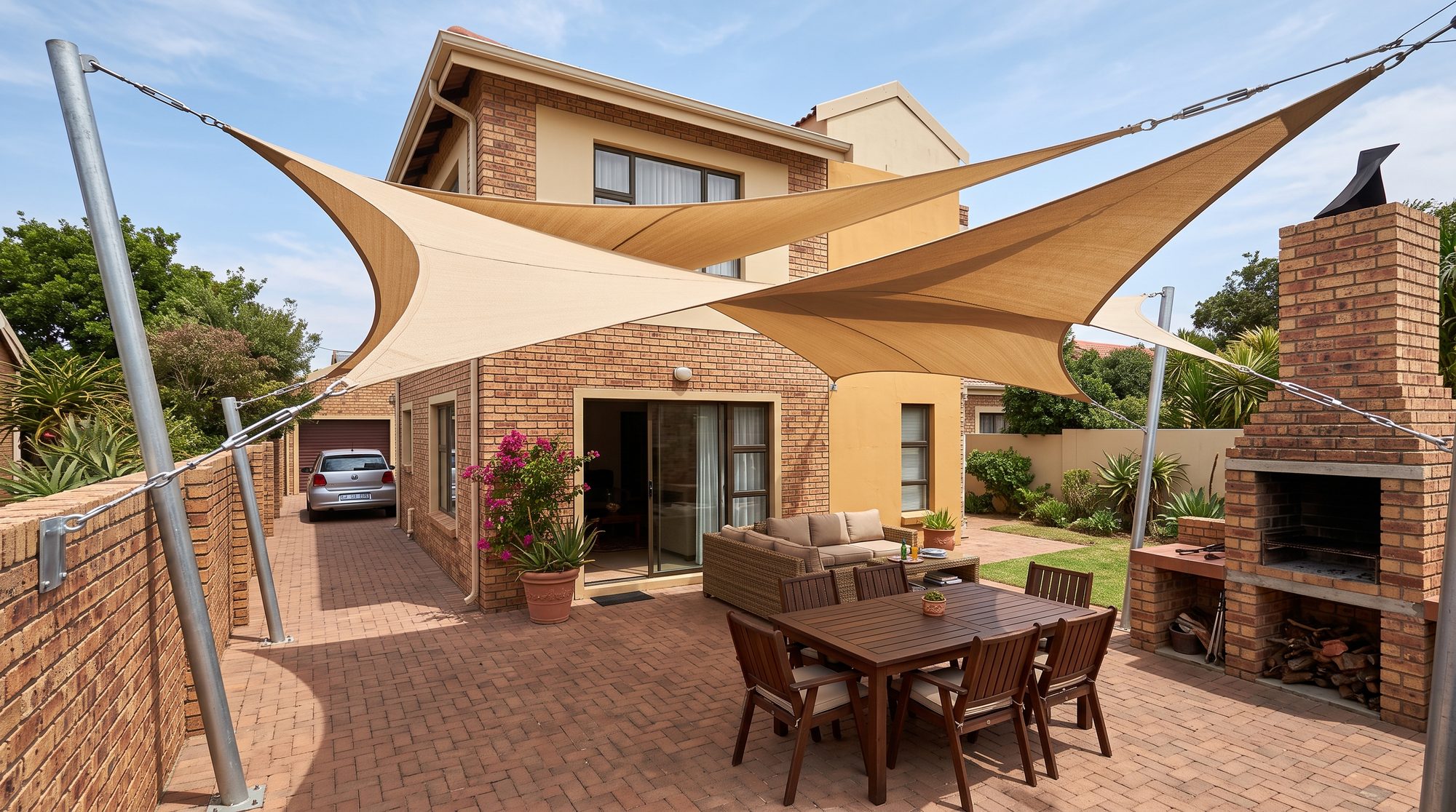
Two overlapping hypar sails anchored to raked posts and the house wall.
Where Shade Sails Work Best
Patios and entertainment areas
Sails throw shade without enclosing the space: braai areas and decks stay open on all sides, and the fabric line lifts the look of the yard instead of boxing it in. Overlapping two sails at different heights covers awkward shapes no rectangle can.
Pools
UV is the pool problem sails solve — a 95 percent knit over the shallow end takes the burn out of the afternoon without trapping heat the way solid roofs do. Chlorinated splash does not bother HDPE fabric.
Play areas, schools and crèches
Sandpits, jungle gyms and assembly areas sit under sail shade at schools across the city; the fabric's give makes it the safe overhead choice around children, and shapes can zone areas visually.
Driveways and parking
Sails shade cars handsomely where the geometry suits — a single bay against a wall, a guest spot beside the entrance. Rows of bays are better served by a dedicated structure; the honest comparison sits under shade net carports.
Shapes, Geometry and Tension
Triangles, squares and rectangles cover most briefs, and the hypar — a sail twisted so alternate corners rise and dip — is the Cape's workhorse: the twist stiffens the fabric aerodynamically and sheds the south-easter from any approach angle. Corners pull through marine-grade turnbuckles and shackles to raked posts or engineered wall brackets, and the fabric is drawn to a tension that stops flutter dead. Flat, slack sails flog themselves to rags here; twisted, tight ones last a decade.
Fabric: Knitted Shade or Waterproof Sail
Knitted HDPE sail cloth in 80 to 95 percent shade factors is the standard: cool underneath, wind-porous, UV-warranted up to 10 years, stocked in greens, greys, charcoal, beige and brick. Waterproof sail membrane turns the same geometry into rain cover, set steeper so water runs off a corner; it suits dining decks that must work through winter. Rain-first structures are compared under waterproof shadeports.
Shade Sail Prices in Cape Town
Small residential triangles start around R4,500 installed; most home sails land between R6,500 and R15,000 by the time size, fabric grade and post count are set, and multi-sail or commercial layouts are priced off the site plan (2026). Posts in concrete are the main cost variable — corners that anchor to sound masonry save real money. Wider structure pricing context sits under shadeport prices in Cape Town; sail quotes themselves are free on 062 397 4233 or through the form.
Call 062 397 4233 (Monday–Friday, 08:00–17:00) or use the form for a free quote.
Frequently Asked Questions
- What does a shade sail cost in Cape Town?
- Small residential triangles start around R4,500 installed, and most home sails land between R6,500 and R15,000 depending on size, fabric and how many new posts must be planted (2026). Multi-sail and commercial layouts are quoted on the site plan.
- Are shade sails waterproof?
- Standard sails are knitted HDPE and let rain through. Waterproof sail fabric is available and needs a steeper fall so water runs off one corner rather than pooling. The choice is made per sail at quote stage.
- Can a shade sail survive the Cape south-easter?
- Yes, engineered correctly: the twist built into a hypar sail sheds wind from any direction, fittings are marine-grade turnbuckles and shackles, and posts are raked and concreted against the pull. A flat, slack sail is what fails in the wind — tension and geometry are the whole game.
- What shapes do shade sails come in?
- Triangles, squares, rectangles and the twisted hypar form of any of them. Larger areas overlap two or three sails at different heights, which reads better and sheds wind better than one giant sail.
- Can sails fix to the house instead of posts?
- One or two corners can anchor to sound masonry with engineered brackets, saving posts. Roof-trust and cavity-wall fixings are assessed on site, and any corner without solid structure gets a raked steel post in concrete.
- How long do shade sails last?
- Quality HDPE sail cloth carries UV warranties up to 10 years and typically serves 8 to 12 in Cape Town sun with annual re-tensioning. Fittings outlast fabric when they are marine-grade; coastal installations get an annual rinse to keep salt off the stainless.